TABLE OF CONTENTS+
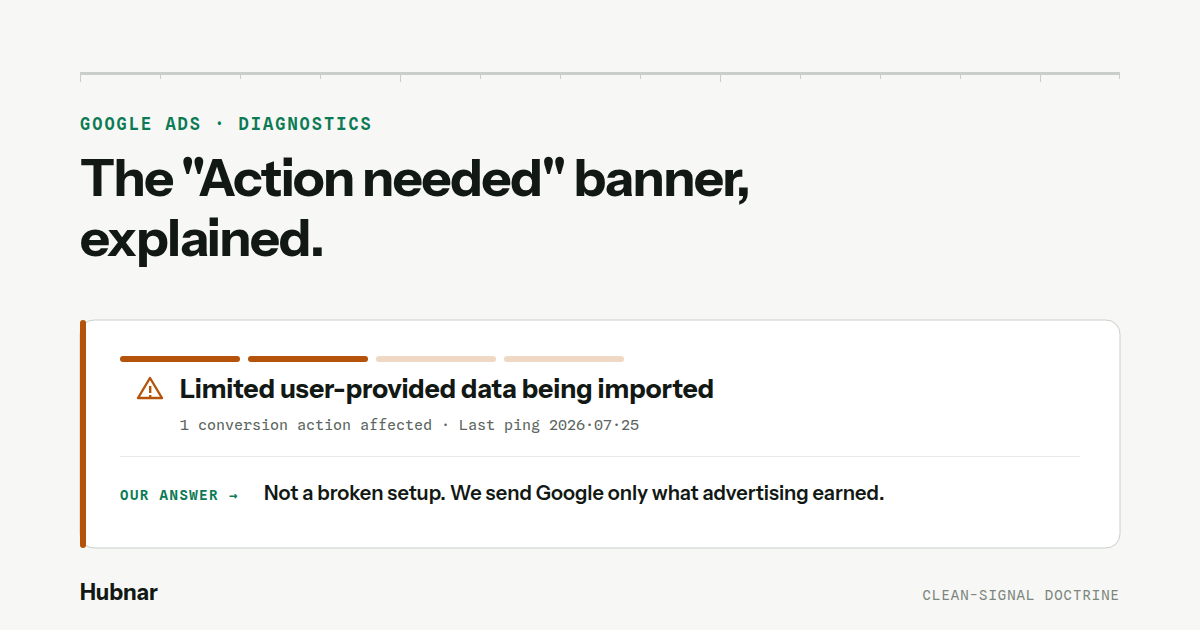
If you use enhanced conversions and open the Diagnostics panel in Google Ads, you may find an orange banner that reads "Action needed", with the specific alert: "Limited user-provided data being imported." Google explains that you are "only importing events that include both user-provided data and Google identifiers like GCLID," and recommends importing all events with user data — even the ones with no ad click.
This looks alarming. It is not. It is a design choice — and understanding why requires understanding what Google is actually asking for, and what happens to the data on the other side.
What Google is asking for
Google's recommendation is literal: send every conversion that carries hashed user data (email, phone), whether or not it originated from a Google ad. A shopper who arrived through organic search, typed your URL directly, or clicked a link in an email — Google would like those conversions uploaded too.
Google's stated rationale is that its systems can sometimes match a conversion back to an earlier ad interaction using first-party data, even when the click identifier is missing. So from Google's point of view, more raw data means more chances to reconnect a sale to a campaign.1
What actually happens to a conversion with no ad click
Here is the mechanic that most guides skip. When you upload conversions matched by user data instead of a click ID, Google attempts to attribute each one to a prior ad interaction. If it finds one, the conversion is recorded. If it does not, the conversion is simply not counted.
"If you upload 100 conversion actions with email addresses, and Google can only match 70 of those email addresses, then only 70 of the conversions will be recorded. Unmatched conversions are simply not recorded."2
This single fact dissolves the most common fear about "clean" conversion sending — that withholding organic sales makes your reported numbers look artificially low, or that sending everything would inflate them. Neither is true. Google discards the conversions it cannot tie to an ad. A purely organic sale, uploaded, is filtered out on Google's side regardless of what you do.
So what is the warning really about?
Once you separate the two things Google bundles together, the picture clarifies. There are two distinct reasons Google wants "everything":
Reason A — recovering lost ad-driven sales
Some sales genuinely came from an ad, but the click identifier was lost along the way — stripped by a privacy browser, truncated by a redirect, gone by the time the order closed. These are real ad conversions wearing no visible badge. Recovering them with first-party data is correct and valuable, and it is exactly what a serious tracking layer should do.
Reason B — feeding the model with everything else
The second reason is broader: Google would like the full stream of your customer data — including purely organic buyers — as general fuel for its matching and modeling systems. This is the part the warning is really pushing. And it is the part where the interests of the advertiser and the platform quietly diverge.
Where we stand — and why
Our position separates these two cleanly:
- Reason A: we already do this. When a sale is genuinely ad-driven but its click identifier is missing, we send it with first-party data so the conversion is recovered rather than lost. This is a core part of what the product exists to do.
- Reason B: we deliberately do not. We do not report purely organic or direct sales to Google as ad conversions. Not because we cannot — because doing so sends the advertising system a signal that has nothing to do with advertising.
The reasoning is a doctrine we hold to: report to Google only what advertising actually earned. A conversion is a claim — "this sale came from your ad." Making that claim about a sale that came from organic search is not a small inaccuracy Google will quietly filter; it is noise pushed into the exact system you are trying to keep honest.
We tested this — for months
This is not a belief we adopted from a whitepaper. Over roughly four to five months, on a live account, we ran three measurement setups side by side: our own clean-signal approach (ad-driven only), a popular tool that uploads everything, and Google's own first-party app. We watched the numbers in the Ads panel across all three.
The result was clear and, for us, decisive: the conversion counts in the Ads panel came out nearly identical. Sending everything did not produce more counted conversions. The extra data the "send it all" approach pushed through was, in the end, the noise Google was going to discard anyway — matched to nothing, recorded as nothing.
We want to be precise about what that experiment does and does not prove, because precision is the whole point of the doctrine:
- Proven: uploading non-ad conversions did not increase the conversions Google counted. There is no visible loss from sending clean.
- Reasoned, not proven: that a cleaner signal helps Smart Bidding learn better over time. This is a mechanical argument we find sound — a model trained on honest labels should generalize better than one trained on noise — but it is not something we ran a controlled A/B on, and we will not dress it up as a measured promise.3
The honest bottom line
Under uncertainty, weigh the two paths by what is actually known:
- Our path has no known cost — Google discards the unmatched conversions we withhold, so the reported numbers do not suffer.
- Google's path has no demonstrated benefit in our own measurement — the extra data did not move the counted total, and the modeling upside remains an undocumented claim.
Given that, keeping a proven doctrine intact for the sake of an unproven upside is the rational choice. The orange banner is not a broken setup. It is the visible fingerprint of a deliberate decision: we send Google the truth about what its ads earned, and nothing else.
Notes
- Google Ads Help, About enhanced conversions — enhanced conversions send hashed first-party data to attribute conversions back to ad events. support.google.com/google-ads/answer/9888656
- On unmatched conversions not being recorded — practitioner explanation of enhanced-conversion matching without a click ID. sol8.com/import-conversion-actions-without-gclid
- Google Ads Help, Offline conversion imports FAQs — enhanced-conversion matches require an ad interaction within the attribution window (63 days for user-data matches). support.google.com/google-ads/answer/10029210
FAQ
STRAIGHT ANSWERS
Q1Is the "Limited user-provided data being imported" warning an error?+
No. It is an optimization suggestion, not a malfunction. Google is asking you to also upload conversions that never came from an ad. Choosing not to is a valid measurement decision, and your enhanced conversions setup is still active and working.
Q2If I don't send organic conversions, do my Google Ads numbers look artificially low?+
No. Google only records an uploaded conversion if it can match it to a prior ad interaction. Purely organic sales are discarded on Google's side whether or not you send them, so withholding them does not lower your reported conversion count.
Q3Does sending all conversions inflate my ROAS or conversion count?+
It does not inflate the count, because Google filters out the conversions it cannot attribute to an ad. In our own months-long side-by-side test, sending everything versus sending only ad-driven conversions produced nearly identical numbers in the Ads panel.
Q4Why send ad-driven conversions with user data at all, then?+
Because some genuinely ad-driven sales lose their click identifier along the way. First-party data lets those real conversions be recovered instead of lost. That is different from sending organic sales — one recovers advertising's true result, the other injects noise.
Q5Will keeping the signal clean hurt Smart Bidding?+
We have no evidence that it does. Whether a cleaner signal actively helps bidding over time is a reasoned argument, not something we measured with a controlled test, so we won't state it as a promise. What we did measure is that clean sending costs nothing in counted conversions.
RELATED READINGS